Konica Minolta Alpha-7 Digital

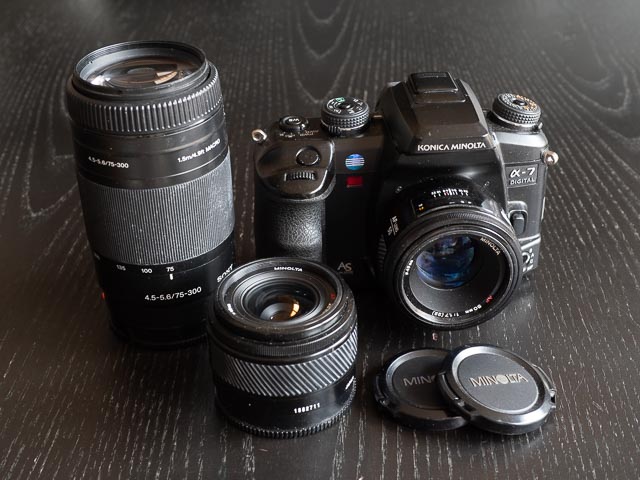
Introduction to the Konica Minolta Alpha-7 Digital
| Announced | September 2004 |
|---|---|
| Camera type | Digital SLR |
| Camera size | 845 grams 150 x 106 x 78 mm (inc. battery) |
| Sensor type | CCD |
| Sensor size | APS-C (23.5 x 15.7 mm) |
| Resolution | 3008 x 2000 (6 megapixels) |
| Memory card | Compact Flash (Type I or II) |
| Battery | NP-400 |
| Lens | Minolta AF (i.e. Sony Alpha) |
| Full specifications | |
If you just want to see some photographs, skip straight to the results section.
Minolta might not be a familiar name to many younger photographers, but back in the 1970s, 80s and 90s Minolta was a firm fixture in what was known by many as the "Big Five", that is to say the 5 biggest Japanese photography companies of the film era: Canon, Minolta, Nikon, Pentax and Olympus. And Minolta had a strong reputation for innovation. In fact what some might consider the most important game-changing SLR cameras of the film era was from Minolta: the Minolta Dynax 7000 (to give it it's European name), the camera that introduced an excited camera buying public to the SLR with body-integral auto-focus back in 1985.
The 7000 was marketed under the Dynax name in Europe, the Maxxum name in North America, and the Alpha name in Asia, a rather confusing global marketing strategy for sure! In 2003 Minolta merged with Konica to become Konica Minolta, and in 2004 Konica Minolta launched their first DSLR camera, the Konica Minolta Dynax 7D. So some years after Canon, Nikon and Pentax DSLRs to mount them on, finally owners of Minolta auto-focus lenses could do the same.
Well, I say this camera, but this camera was known as the Konica Minolta Maxxum 7D in North America, and the Konica Minolta Alpha-7 Digital in Asia, and I was a bit surprised by my example arrived and I found myself lifting a Konica Minolta Alpha-7 Digital out of the box… surprised because I am in Europe! That mean my example must have been a personal import of some sort.
Minolta (and later Konica Minolta) never deviated from the Dyanx/Maxxum/Alpha branding strategy, so when in 2006 Konica Minolta finally decided to quit the photography market and sold all the assets of their camera division to Sony, Sony thankfully decided simplify global marketing by using the Alpha brand world-wide… phew!. So sadly the venerated Minolta name had finally disappeared from the market, but it was clear to anyone the moment they picked it up; the first Sony DSLR was really just an updated Konica Minolta DSLR.
I'm going to simplify Minolta's confusing global marketing by just calling this camera the 7D from now on!
Minolta's legion of camera fans had been waiting a long time for a DSLR on which to use their collection of Alpha mount lenses, so what kind of camera did Konica Minolta give them in the 7D? The 7D was a high-end consumer camera design to compete with cameras like the Nikon D100 and the Canon EOS 20D. It had 6 megapixels (pretty standard for the early 2000s, though Canon had started a move to 8 megapixel cameras by launching the Canon EOS 20D in August 2004), and was a big, hefty camera with a button and dial heavy user-interface to satisfy experienced enthusiast users. There were two things in particular that made the 7D rather different from it's competitors. Firstly, the 7D was the first camera to have no LCD status display on either the top plate or the back of the camera, relying exclusively on the rear monitor for a status display. This was seen as a dramatic deviation from the norm back in 2004. Secondly, the 7D was the first interchangeable lens camera to feature in-built image stabilisation (often shortened to IBIS).
These two things may seem like little things, but they went on to be copied by many other camera firms, and I think it's fair to say marked out Minolta as a company that was determined to continue with it's long held reputation for innovation. Indeed, one can't help but wonder what sort of weird and wonderful innovations Minolta might have come up with had they survived in the photography industry. Fortunately Sony have shown them selves to be just as keen on innovation as Minolta ever were, so perhaps there is no need to wonder!
Buying an Konica Minolta Alpha-7 Digital in 2025
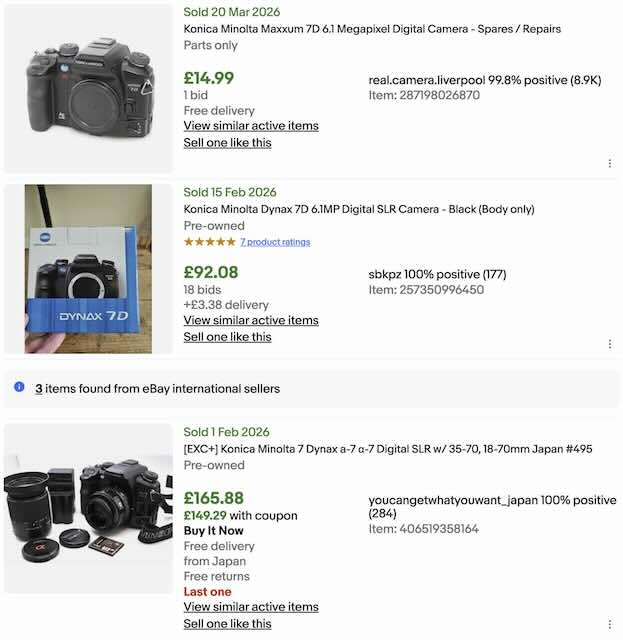 The 7D is actually a rather rare camer, so you'll probably need to set up a saved search with notifications on eBay and then wait patiently for one to turn up. A search for the 7D on eBay conducted 10 April 2026 revealed just one example in the U.K. going for a stonking £217!, and a number from international sellers generally asking £150-200. Yeah, for a 6 megapixel DSLR from the early 2000s! Bear in mind that prices for similar cameras from more mainstream companies like Canon and Nikon fall in the £40-80; range. But with patience you should be able to find one for less than £100. Illustrated to the left is a search for sold listings on eBay, again carried out 10 April 2026 which returned 2 results: a broken parts-only example selling for £15 and a working one that sold at auction for £92. You may have to wait a year or two to find a good working example for a reasonably price, but long as you don't mind waiting, there's no need to spend more than £100.
I got mine from CeX for a mere £65 with post and packaging, including a battery and charger. CeX lets you sign up for stock notifications for specific items which can be a great way to get rarer items. And it's worth bearing in mind that they include a 5 year warranty with everything, which is a nice bonus. It was listed under the UK model name of Konica Minolta Dynax 7D, but when I opened the box I pulled out an Asian market Konica Minolta Alpha-7 Digital! But I didn't mind too much given how long I had waited to pick up one of these cameras for a reasonable price.
The 7D was the first of just 2 Konica Minolta DSLRs. The second was the 5D, with the same sensor but a lower-end body that was design to compete with Canon EOS Digital Rebel cameras. I mention is here as it is much more common and can generally be found for half (or less!) the cost of the 7D. So if you really want to add a Konica Minolta DSLR to your collection, a 5D should be a lot easier (not to mention cheaper!) to find.
Konica Minolta Alpha-7 Digital Body Tour
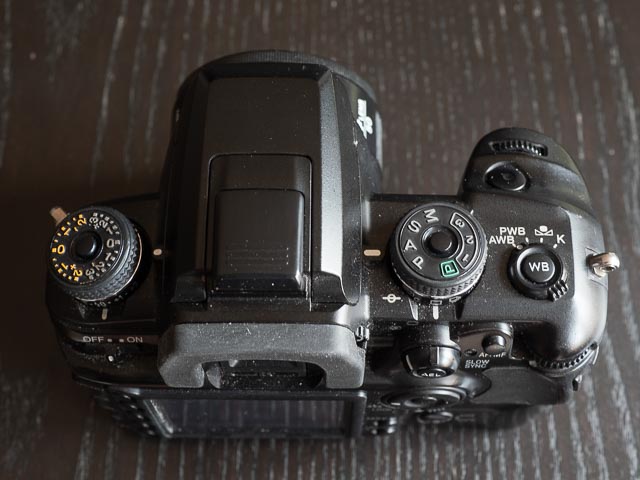 The 7D is clearly a close relative of the Minolta Dynax (or Maxxum/Alpha) 7 film SLR camera launched in 2000. The top plate controls of the 7 and 7D are pretty much identical. But this is no franken-camera made by literally tearing the film door off a film camera and bolting on a set of digital gubbins (yes, I'm looking at you FujiFilm S1 Pro, S2 Pro and S3 Pro!): No, the 7D is a sophisticated, well designed and well integrated digital DSLR. But let's start with those photographic controls from the top.
To the left of the pentaprism and viewfinder we have an exposure compensation dial with a locking button at the centre. On one side of the dial you can set up to 3 stops of exposure compensation in half stop steps, while on the other you can set up to 2 stop of exposure compensation in third stop steps, and under that you can just about glimpse a second nested dial for flash exposure compensation (+/- 2 stops in half stop steps). And to the right we have the exposure mode dial with the familiar PASM modes, plus a a green fully automatic mode and 3 custom settings. Under this is another nested dial for setting the drive mode. (We'll see those nested dials better in a moment when we look at the back of the camera). Then there is a comprehensive white balance control. To the front you can see the shutter button and front command dial.
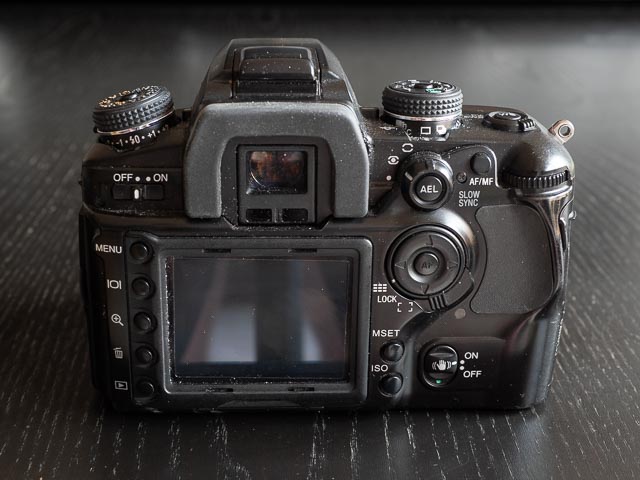 Moving to the back of the camera, the button and dials are still packed in! To the left of the viewfinder there is the main on/off switch, while to the right we have a metering mode dial around the exposure lock button (when using flash this button activates slow sync mode instead). The we have an interesting button for quickly switching to manual focus or auto focus: if the focussing mode dial on the front of the camera is in any of the auto-focus modes, then hitting this buttons will temporarily switch to manual focus mode, and if it's set to manual focus mode this button will temporarily switch you to single-shot AF mode. I don't recall, off-hand, seeing a similar button on any other DSLRs! And then we have the rear command dial.
Under the focus mode dial/AEL button (completing the controls which are lifted straight from the Dynax 7 film SLR) you'll find a 4 way controller for selecting a focus point with a 'Spot AF' button at the centre and surrounded by a dial for selecting focus area mode. This dial has 3 positions: the 'Lock' position in the center locks you to the currently selected focus point and prevents it from being changed; to the left of that is a mode which allows focus points to be manually selected, and to the right of the 'Lock' position is the wide focus area mode which selects the focus point automatically. The 4 way controller is also used to navigate menus on the rear monitor. Under 3 more controls: the 'MSET' is used for added the current settings of the camera to one of the '1', '2' or '3' positions on the mode dial' ISO button is self explanatory, and the final control is a switch for turning the IBIS on or off.
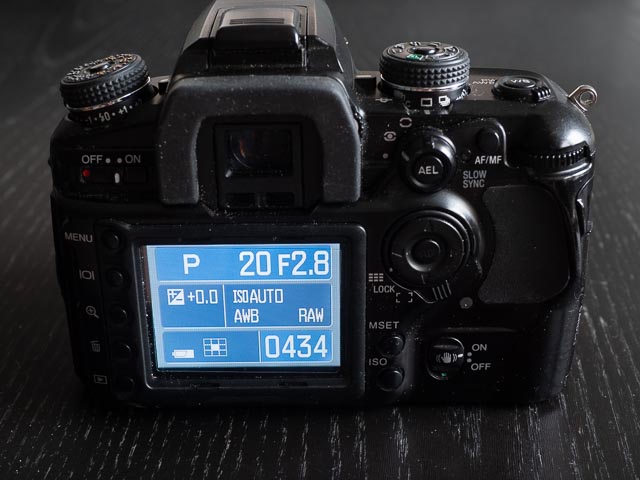
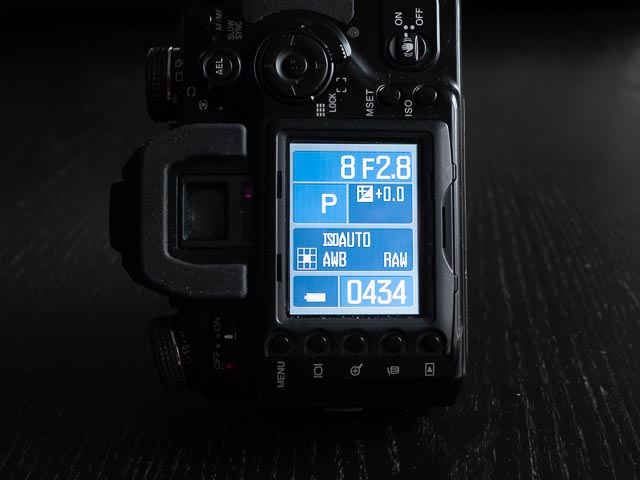 The monitor is of course one of the major things you'll find on the back of the camera, and for it's time, the 2.5" screen was one of the largest on any DSLR. Unlike most DSLRs of the time, there is no status LCD screen on the top plate, so most of the time the rear monitor displays a summary of the current settings. A nice feature is that it adjusts automatically depending on whether the camera is being held vertically or horizontally. Hit the 'Menu' button and of course you access the menu system. As the great majority of the controls can be controlled via all the dedicated buttons and dials, the menu system is mercifully simple!
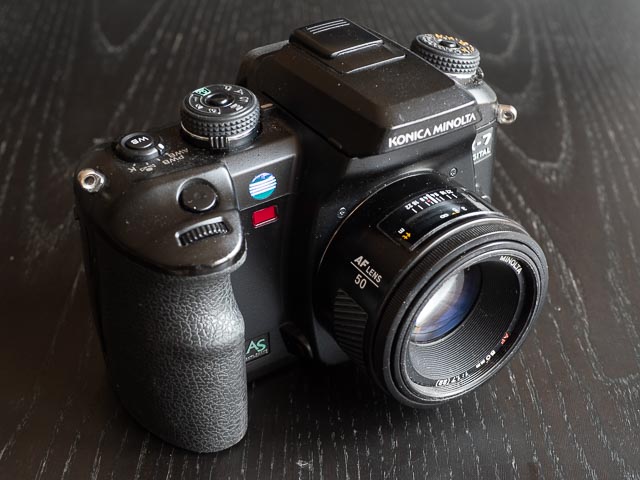
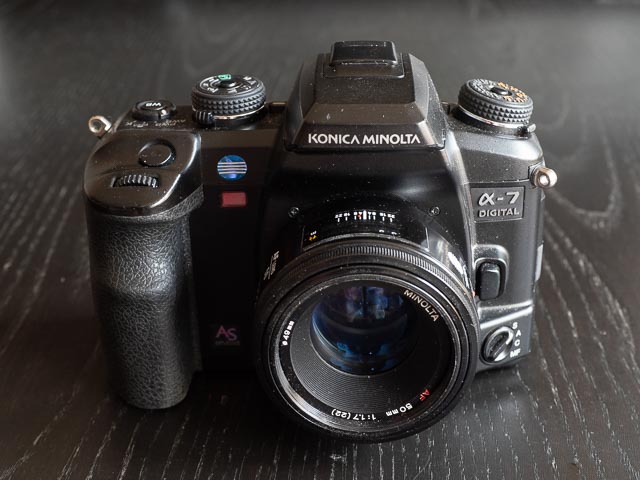 On the front of the camera, to the left of the lens, we get another look at the shutter buttons and the front control dial. And at the bottom, next to the lens, there is a depth-of-field preview button. And to the right of the lens there is the focus mode dial and the lens release button.
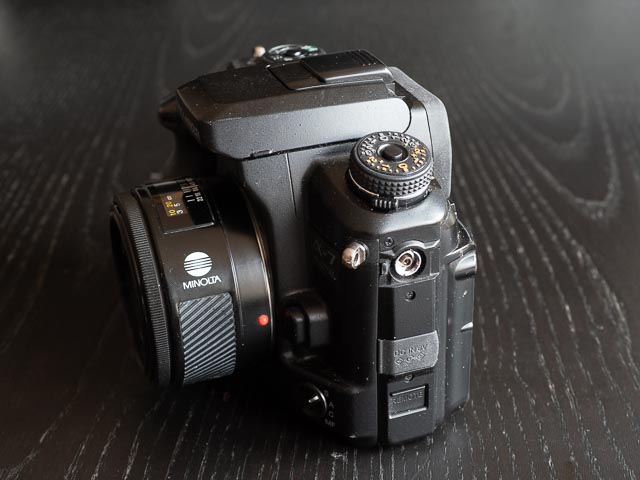 On the left hand side of the camera (as you're using it) you'll find a selection of ports. At the top is a PC port for external flash units. Below that is a port for the AC adapter, and at the bottom is a port for a cabled remote control.
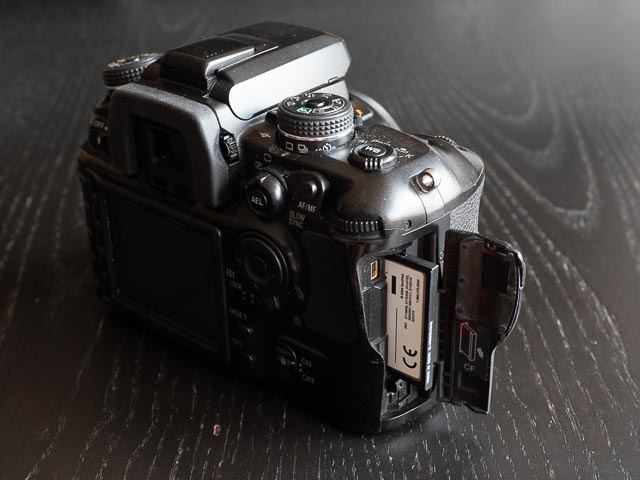
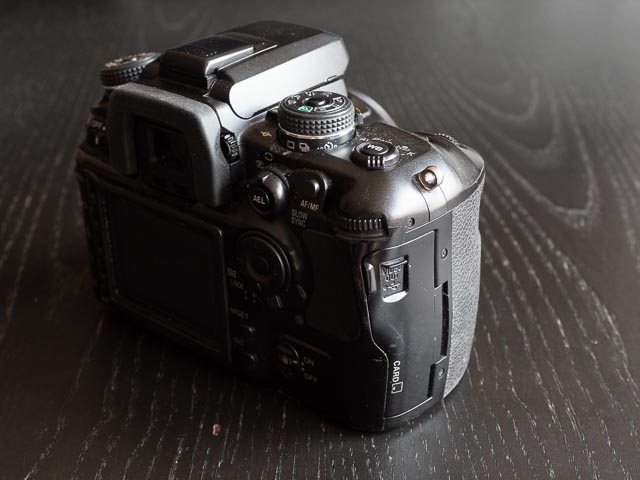 On the right hand side of the camera (as you're using it) you'll find the memory card door (like most cameras of this time it takes a CompactFlash card). At the top of the memory card compartment there is a video out port for connecting your camera to a TV. This port can be accessed without opening the memory card compartment using a small sliding opening in the memory compartment door. LIke on most DSLRs, on the bottom of the camera you'll find a tripod bush (centred on the lens) and a batter compartment door (For NP-400 batteries). And that's your lot… Phew!!
Using an Konica Minolta Alpha-7 Digital in 2025
There is no doubt as soon as you pick the 7D up that it is a high-end device: large, comfortable, very solidly built, and with everything you need quickly available from a wide array of dedicated controls. The sheer number of controls can be a little intimidating at first, but any experienced photographer will acclimatise to the user interface pretty quickly. At the time this camera was launched it was the first to feature no LCD status display, but there is no need to worry… this camera handles superbly.
The viewfinder is large and bright, and while the auto-focussing system, with it's 9 focusing points, may seem very basic by today's standards, but it was pretty sophisticated by 2004 standards. I found it to be reasonably fast and I had certainly no problems with it the kind of day-to-day photography I was trying to accomplish while I was using this camera. I didn't try much manual focusing with the 7D: like most auto-focus SLR cameras the focusing screen doesn't have a very course grain to allow focus to be visually confirmed, but the focus confirmation light works in manual focus mode to help nail focus.
There were, of course, a few of the minor annoyances you often get with vintage digital cameras: for example, the EXIF data of the files from this camera record the focal length correct, but not the name of the lens, but as I always say, that's all part of the fun of stepping down memory lane with a camera like this! Overall I found the 7D to be a pleasure to you.
Konica Minolta Alpha-7 Digital results
In all honesty the results I got from the 7D didn't really blow. That doesn't mean I didn't enjoy them, but the 7D won't go down as my all-time favourite vintage DSLR. I think the Fujifilm S2 Pro, Olympus E-500, Leica Digilux 3 and Sony R1 all gave me colours that I enjoyed more.
All the examples below were taken using the Minolta 50mm f/1.7 standard lens (which has a field of view similar to a 75mm lens on a full-frame camera) and a much more recent Minolta 24-105mm f/3.5-4.5 zoom lens. tThe 24-105mm made for a very nice walk around lens, but I wasn't too happy with the results, which needed a a fairly big contrast boost in Lightroom. I found it had a fair amount of fungus in it which explains that, so it got unceremoniously thrown out! (Fortunately it only cost about £20 so no big loss!).
The colour photographs below were edited to taste in Adobe Lightroom. For the black and white ones I recently got Nik Collection 8 with Silver Efex 8, so I'm back to Silver Efex for black and white conversions, though it'll take a while to get the hang of this software as it has changed a lot since my last version of Silver Efex (version 2!).
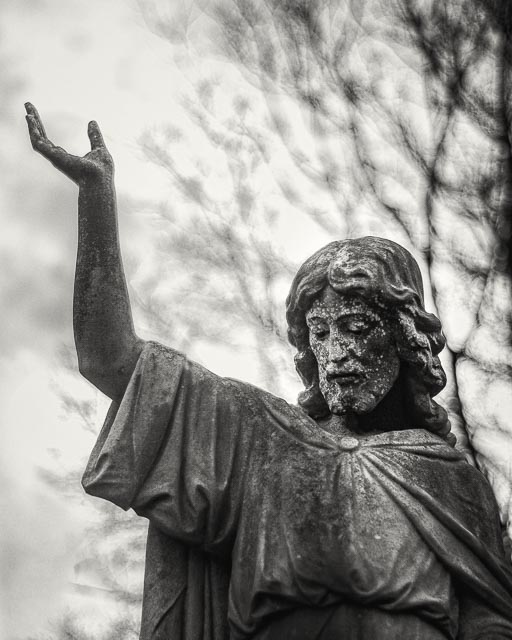
Minolta AF 50mm f/1.7 (f/1.7 - 1/4000 - ISO100)
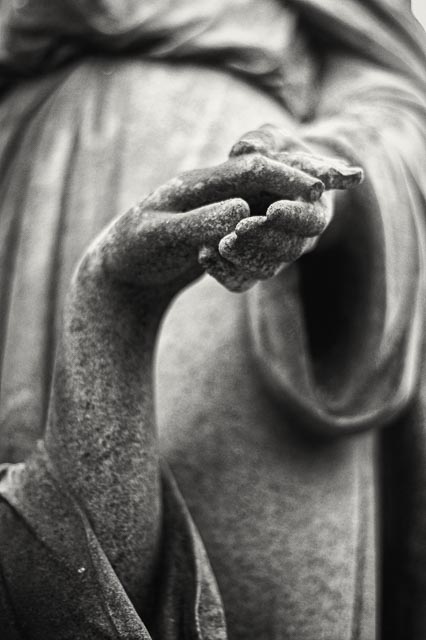
Minolta AF 50mm f/1.7 (f/2.0 - 1/50 - ISO100)

Minolta AF 50mm f/1.7 (f/2.0 - 1/50 - ISO100)

Minolta AF 50mm f/1.7 (f/1.7 - 1/4000 - ISO100)

Minolta AF 50mm f/1.7 (f/1.7 - 1/1000 - ISO100)
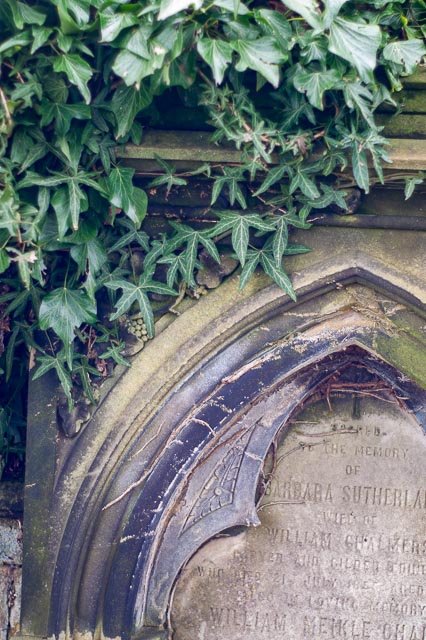
Minolta AF 50mm f/1.7 (f/2.0 - 1/125 - ISO100)
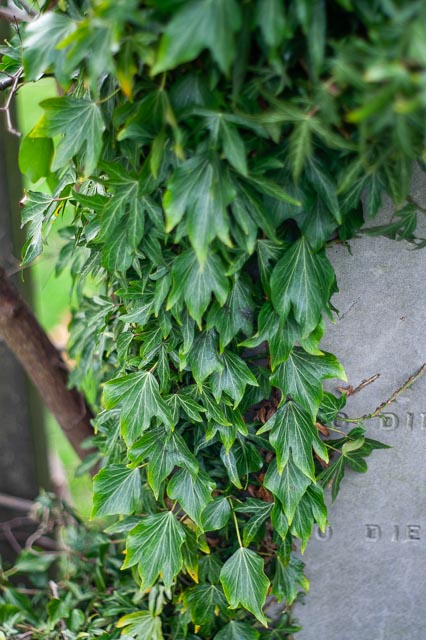
Minolta AF 50mm f/1.7 (f/1.7 - 1/200 - ISO100)

Minolta AF 50mm f/1.7 (f/1.7 - 1/350 - ISO100)
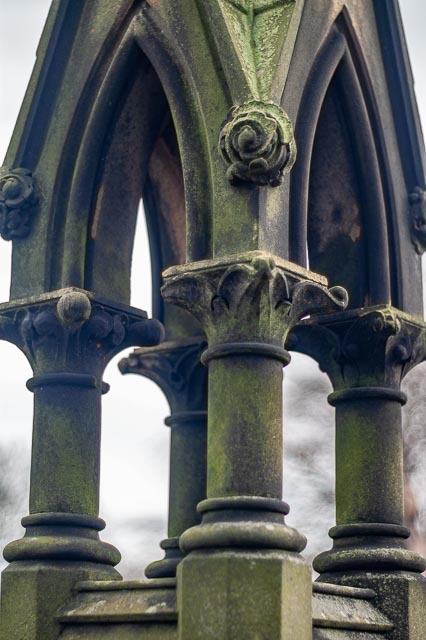
Minolta AF 50mm f/1.7 (f/1.7 - 1/1000 - ISO100)
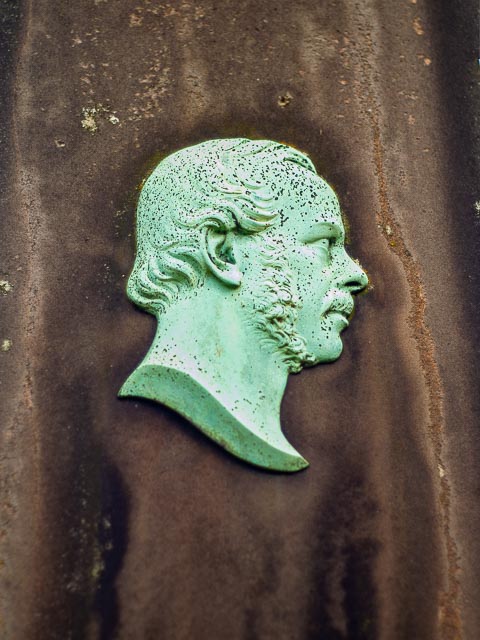
Minolta AF 50mm f/1.7 (f/2.8 - 1/400 - ISO100)

Minolta AF 24-105mm F3.5-4.5 D (105mm - f/4.5 - 1/100 - ISO400)

Minolta AF 24-105mm F3.5-4.5 D (105mm - f/5.0 - 1/200 - ISO400)

Minolta AF 24-105mm F3.5-4.5 D (105mm - f/5.6 - 1/500 - ISO400)

Minolta AF 24-105mm F3.5-4.5 D (90mm - f/4.5 - 1/400 - ISO400)

Minolta AF 24-105mm F3.5-4.5 D (90mm - f/5.0 - 1/160 - ISO400)
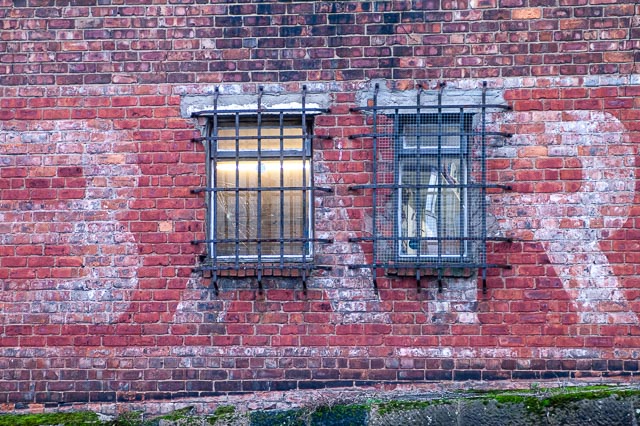
Minolta AF 24-105mm F3.5-4.5 D (75mm - f/5.0 - 1/100 - ISO400)