Canon PowerShot S70
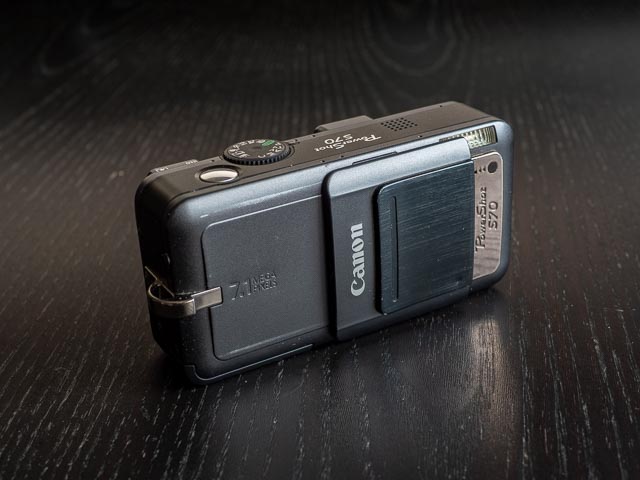
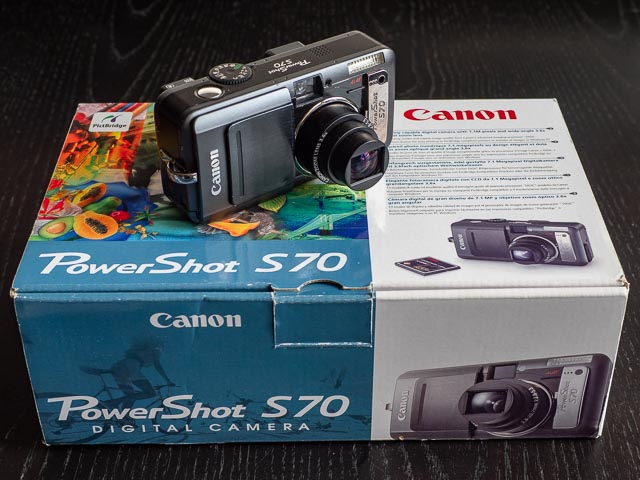
Introduction
| Announced | August 2004 |
|---|---|
| Camera type | Compact advanced digicam with tunnel type optical viewfinder |
| Camera size | 114 x 57 x 39mm 300 grams (inc. battery) |
| Sensor type | CCD |
| Sensor size | 1/1.8" (7.1 x 5.4 mm) |
| Resolution | 3072 x 2304 (7 megapixels) |
| Memory card | Compact Flash (Type I or II) |
| Battery | NB-2LH/NB-2L |
| Lens | 5.8 - 20.7mm f/2.8–5.3 (35mm equiv. 28 - 100 mm, 3.6x zoom ratio) |
If you just want to see some photographs, skip straight to the results section.
The Canon PowerShot S range began with the PowerShot S10 in 1998 as an upmarket counter-part to Canon's mainstream PowerShot A range. But with the launch of Canon's advanced PowerShot G range with the G1 in 2000 the reason d'etre of the PowerShot S range changed somewhat: it became a compact alternative to the PowerShot G range, packaging most of the advanced features and manual controls of the G models into a much smaller and more portable body. That relationship between the PowerShot G and S ranges remained consistent until the final models with smaller than 1" sensors (the G16 and S120) were launched in 2013
My experience with the PowerShot S range began with the purchase of a discontinued and heavily discounted S45 in 2004. I used this camera extensively for about a year before leaving it in Marks & Spencers when shopping in Edinburgh city centre in 2005. I realised what had happened within 5 minutes of leaving the shop and hurried back, but wasn't really expecting to find it still there, and indeed it been picked up by someone else… The search was on for a more recent PowerShot S camera as a replacement, but it took me a while to find one at a price I was happy with. The model I really wanted was the 7mp PowerShot S70 which was the last PowerShot S camera for some time to feature a RAW mode, but I wasn't able to find one at a price I was willing to pay, so in the end I settled for the S70's follow up, the 8mp PowerShot S80.
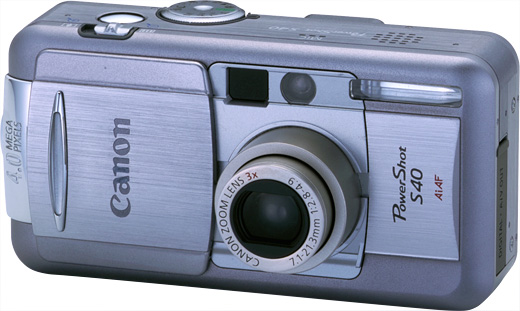 But a short while ago (early November 2025 to be precise) I was just idly browsing eBay (always a dangerous activity for
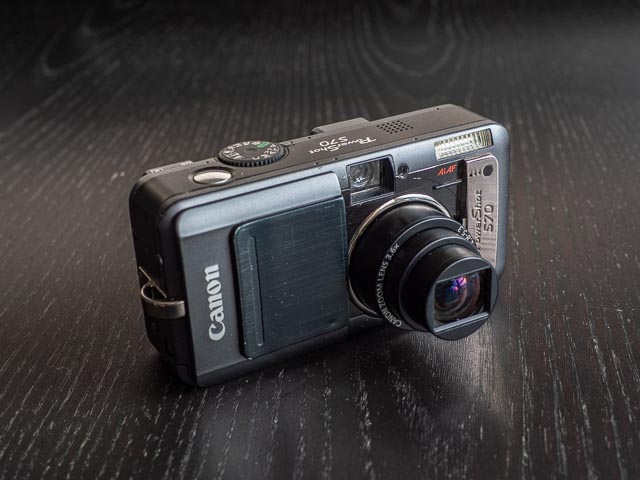
 those of us suffering from G.A.S. us camera collectors) when I spotted this S70, boxed and in what looked like good condition, for a reasonable price, so I pressed that buy button before I even knew what I had done! The S70 was the last camera in the PowerShot S line to feature same design language first introduced with the S30 and S40 back in 2001, albeit with a new and rather stylish dark grey colour. So the S70 features the rather industrial design language from the S30/S40, full manual controls, a RAW mode, a compact size, and a nice wide 28-100mm (35mm equiv.) zoom lens… to me that is a highly desirable combination of features.
Buying a Canon PowerShot S70 in 2025
The Canon PowerShot S70 isn't particularly rare or sought after, so you shouldn't have to spend a fortune to acquire one. A budget of £30-45 should be enough to snag one is good usable condition. I paid £41 (£46 inc. p&p) November 2025 for an example in very nice (but not mint) condition complete with box and all accessories.
Using a Canon PowerShot S70 in 2025
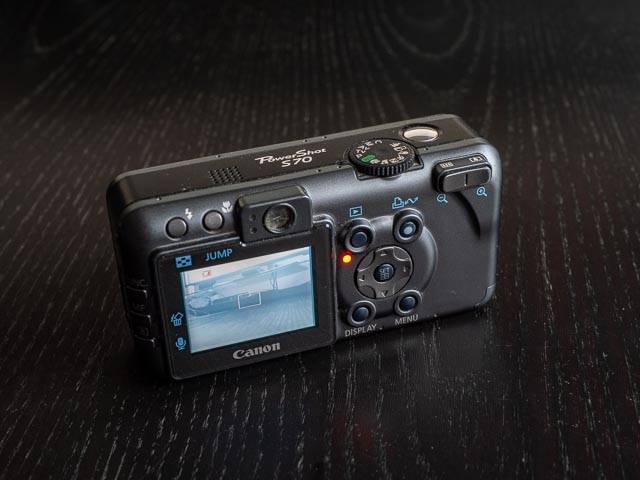 Using the S70 brought back some happy memories from using my S45 more than 20 years ago. The combination of that wide 28-100mm lens and a highly portable size makes the S70 a very pleasant companion, even in his day and age. But it's a shame that access to manual settings isn't quite as easy as it should be. Ideally the four way controller should provide access to both programme shift (using, for example, the left/right buttons) and exposure compensation (using the up/down buttons), but there is no programme shift facility and you have to hit the function button (the top button on the far left of the camera back) to set a variety of shooting setting, including exposure compensation. Fortunately the shooting settings menu you see when you hit that function button is very well design, so that partially compensates for have to use it to set exposure compensation.
Like on most cameras from this era, the simple tunnel type optical viewfinder is not very accurate, but it's still very handy to have when sun light washes out the rear monitor.
The Canon PowerShot S70 results
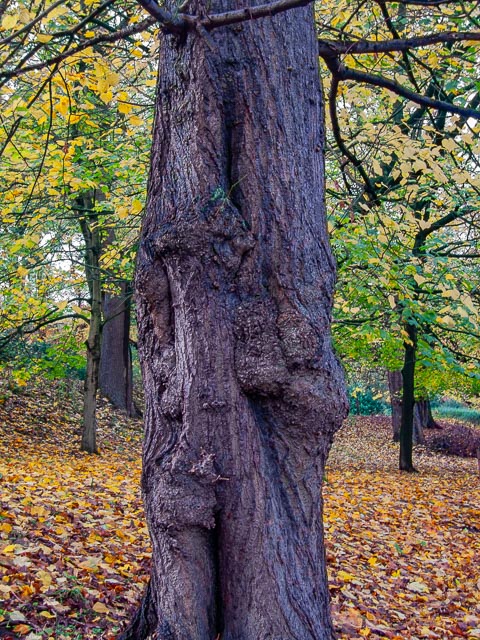
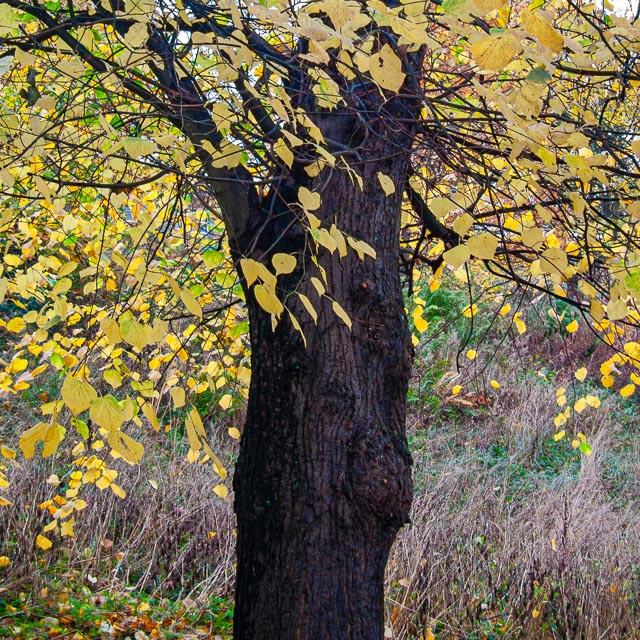
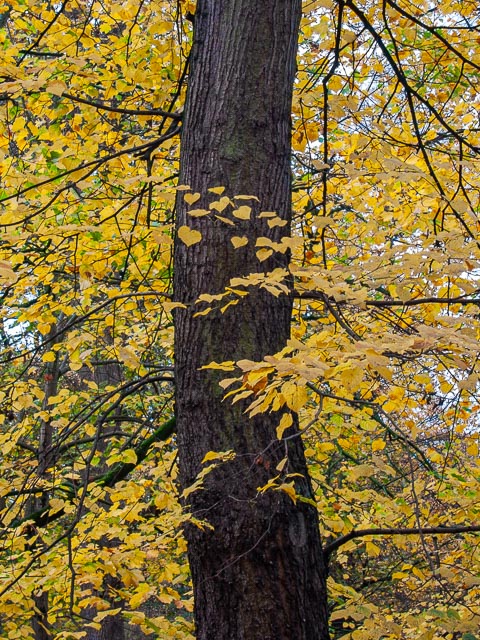
I found the S70 produced very nice images. Images were sharp, colourful and well exposed, giving me some very nice images of the late autumn colours in the streets of Edinburgh.