Four Thirds (and M4/3)
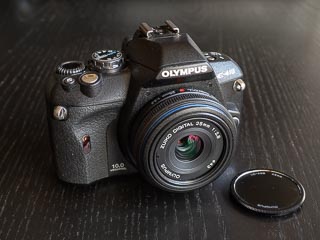
Four Thirds cameras


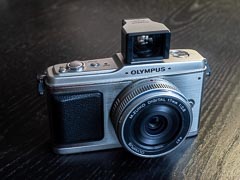
M4/3 cameras

Four Thirds lenses
At some point I'll write articles about the original Four Thirds lenses I own, but it might take me a while…!
The great majority of the DSLRs from Nikon, Canon etc. were very clearly based on their preceding 35mm autofocus SLR architectures. This made a lot of sense as it enabled the legions of owners of said 35mm autofocus SLRs to use their existing lenses and accessories with their new (and very expensive!) digital wonders. But Olympus took a very different route…
Of course Olympus didn't have a lot of choice but to take this route, because alone among the photographic big-boys they simply didn't have a successful 35mm autofocus SLR system to base a DSLR on. Olympus only ever launched one fully-integrated 35mm autofocus SLR, the OM707. This camera was an unmitigated distaster for Olympus that saw them withdraw very nearly entirely from the enthusiast and professional 35mm photography market. In fact I suspect that Olympus only barely survived the OM707 debacle at all.
But let's be glad they did survive! Because their lack a fully fledged 35mm autofocus SLR system to base a DSLR on lead them to do something unique in the photography world: they created a completely new digital SLR system developed from scratch around the needs of digital photography: the Four Thirds system. But note that I didn't call it the Olympus Four Thirds system, because this system was jointly developed by Olympus, Panasonic and Kodak (and, to a lesser extent, Fujifilm, Leica, Sanyo and Sigma) and was intended to be a sort of open standard that any company could sign up to and produce cameras, lenses or accessories for, rather than a proprietary system that one company controlled.
The ideal of an open system with multiple companies producing cameras and lenses was only partially successfully, and it seems only Olympus was fully committed. Olympus produced a total of 15 DSLR cameras, while Panasonic produced 2 and Leica just 1. The Four Thirds system was in production for just 10 years between 2003 and 2013, but in that time Olympus introduced a number of new technologies, including the first interchangeable lens camera with a dust reduction system and the first interchangeable lens camera with live-view. But it was already in a state of terminal decline when Olympus and Panasonic launched the Mirco Four Thirds (and M4/3) system for what went onto become known as "Compact System Cameras (CSCs)", "Mirrorless Interchangeable Lens Cameras (MILCs)", or just plain "Mirrorless" cameras or in 2009.
The basic concept behind the M4/3 system was truly revolutionary: take an SLR and remove the complex mirror and prism system for directing what the taking lens sees up into an eye-level viewfinder and instead use full time live-view with either just a rear monitor or also an electronic eye-level viewfinder. Without the bulky mirror and prism system you could use a much shorter distance between the lens mount and the sensor, and use much more efficient lens designs to achieve much more compact interchangeable lens cameras. Mirrorless cameras have now almost completely replaced the DSLR in the mainstream market place both entry level, advanced enthusiast and professional cameras.
The M4/3 system was far more successful that the original Four Thirds system. At the time of writing (2026), it's now 17 years since it's introduction, and it's still going strong. Olympus sold it's camera making division to become to Japan Industrial Partners in 2020 when it was also renamed "OM System". In 2026 a management buyout made OM System a fully independant company. Having revolutionised an entire industry, the first mirrorless system is now just one of many. And you can even use your original Four Thirds SLR lenses on your OM System mirrorless camera with full function, including autofocus using the original Olympus MMF-1, MMF-2 or MMF-3 adapters, and many third party companies now make similar adapters (OM System have never made their own version of any of the Olympus adapters).